Wednesday, 14 May 2014


Tuesday, 13 May 2014
Creatures in Spanish Mythology
What mythical creatures did the Spanish believe in?
One of the more famous is the Chupacabra
There many more mythical creatures and beings mentioned on which I will be doing more research on and share with you as I go.

Chupacabra: The Chupacabra or chupacabras is a creature resembling a living gargoyle that is said to exist in parts of Latin America (mainly Mexico). The chupacabra is also reported to have been seen by multiple eye-witnesses in Calaveras County, California. According to these reports, the creature was sighted for the first time in the early to middle 1990s, harming animals of different species – although it is now thought that people did this themselves.
Translated literally from Spanish as “goat-sucker”, the chupacabra is said to attack small livestock and drink their blood. Some witnesses reported seeing a small, dark green figure around the areas of the killings, giving police and news reporters the feeling that the chupacabra could, in fact, be an extra-terrestrial figure. Soon after the animal deaths in Puerto Rico, other animal deaths began being reported in other countries, such as the Dominican Republic, Argentina, Bolivia, Chile, Colombia, Peru, Brazil, the United StatesMexico.
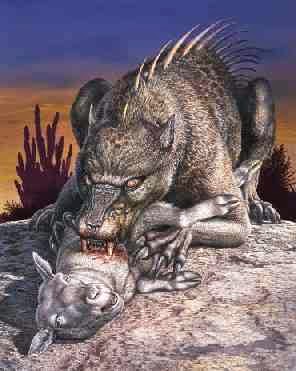
Both in Puerto Rico and Mexico, El Chupacabras gained urban legend status. In July of 2004, a rancher near San Antonio, Texas, killed a hairless, dog-like creature (the Elmendorf Creature) that was attacking his livestock. As of yet, no one has been able to determine just what the creature is. In October of 2004, two animals which closely resemble the Elmendorf creature were observed in the same area. The first was dead, and the second was noticed by a local zoologist who was called to identify the animal while she was traveling to the location where the first was found.
The Chupacabra has been spotted as far north as the Carolinas. Chupacabras are said to prominently appear in two specific forms. The first and most common: a lizard-like being, appearing to have leathery/scaly greenish-gray skin and sharp spines or quills running down its back. It stands approximately 3-4 feet high, and stands/hops in a similar fashion as a kangaroo (in at least one sighting, the creature hopped 20 feet). This variety is said to have a dog or panther-like nose and face, a forked tongue protruding from it, large fangs, and is said to hiss and screech when alarmed, as well as to leave a sulfuric stench behind.

The second variety also stands/hops as a kangaroo, and it has coarse fur with grayish facial hair. The head is similar to a dog’s, and its mouth has large teeth. Witnesses claim some chupacabras are covered with black hair, have red eyes, a bulbous head, and bat-like wings. Sometimes they crawl on all fours and other times they stand erect (like prairie dogs do). They are very quick, can climb well, and usually run away when seen.
Some say their eyes have the ability to hypnotize and paralyze their prey-the prey animal is mentally stunned. This allows the chupacabra to suck the animal’s blood at its leisure. The effect is similar to a snake or spider that stuns its prey with venom. The chupacabra sucks all the animal’s blood (and sometimes organs) through a single hole or two holes, unlike other predators that tear the corpse apart.

I have also found this reference to Chupacabr

Chupacabra means "goat Sucker". This Creature was reported to have been seen throughout the Caribbean, several countries of South America and even in Florida. It has been reported that this creature kills animals by sucking all the blood from them. There have been found many dead goats and farm animals throughout these countries. These animals where found with puncture wounds around there neck. Some have reported that the creature is alien in origin and that UFO¹s have brought them to us. Other say that they are creatures created by the government.
Chupacabras have reportedly killed thousands of animals in Puerto Rican and the United States. Dozens of people have claimed to have seen this animal.
Chupacabras are described as about four feet tall when standing errect, have huge red elongated eyes, grey skin that is part fur and part feathers, short arms with claws, legs like a kangaroo, and a line of sharp spikes down the middle of it's back. They are supposedly very powerful animals. Some report that the chupakabras have wings and can fly.

Chupacabras seeks out farm animals including goats, chickens, and horses. It punctures their flesh and literally sucks the blood from their bodies. Internal organs have sometimes been removed.
Chupacabras have also been seen in other countries, some with different description, sometimes with the head of a grey alien. The Chupacabra has been spotted in the southern part of the United States included the desert of southern California.
Often orange balls of lights show up at the same time as the reports of Chupacabras. Many create a link with UFOs' and Chupacabra's based on this.

One of the more famous is the Chupacabra
There many more mythical creatures and beings mentioned on which I will be doing more research on and share with you as I go.
Chupacabra
Translated literally from Spanish as “goat-sucker”, the chupacabra is said to attack small livestock and drink their blood. Some witnesses reported seeing a small, dark green figure around the areas of the killings, giving police and news reporters the feeling that the chupacabra could, in fact, be an extra-terrestrial figure. Soon after the animal deaths in Puerto Rico, other animal deaths began being reported in other countries, such as the Dominican Republic, Argentina, Bolivia, Chile, Colombia, Peru, Brazil, the United StatesMexico.
Some say their eyes have the ability to hypnotize and paralyze their prey-the prey animal is mentally stunned. This allows the chupacabra to suck the animal’s blood at its leisure. The effect is similar to a snake or spider that stuns its prey with venom. The chupacabra sucks all the animal’s blood (and sometimes organs) through a single hole or two holes, unlike other predators that tear the corpse apart.
I have also found this reference to Chupacabr
Chupacabras have reportedly killed thousands of animals in Puerto Rican and the United States. Dozens of people have claimed to have seen this animal.
Chupacabras are described as about four feet tall when standing errect, have huge red elongated eyes, grey skin that is part fur and part feathers, short arms with claws, legs like a kangaroo, and a line of sharp spikes down the middle of it's back. They are supposedly very powerful animals. Some report that the chupakabras have wings and can fly.
Chupacabras have also been seen in other countries, some with different description, sometimes with the head of a grey alien. The Chupacabra has been spotted in the southern part of the United States included the desert of southern California.
Often orange balls of lights show up at the same time as the reports of Chupacabras. Many create a link with UFOs' and Chupacabra's based on this.
Not very pretty beings are they? But they are living beings just the same just from a different species that any we have classified and proven to date. It does not mean they are not real for one thing that is certain, that is the Chupacabras has been and still remains to be quite real for many folks. I remember a few years back, the Hollywood stars gossip gazette The National Enquiere sensationalizing these phenomena quite well.
But on the other hand according to them we all had aliens hiding in out closet and the men in black and the Area 51 people were looking for them. Maybe The National Enquierer knows more than the rest of the media does, that wouldn't be hard to believe with the way these fixed news people report the news.
☾☼ ᵔᴥᵔ ᴥ•.¸¸.•´ ... ´¯) ¸.☆´¯) (¸☆´ƸӜƷ❤❤♪♫♪❤ƸӜƷ☼
✿¸.•*""*•.¸ ●c¸ ★ . •✿'✿○ ° ★. *. . ¸. ° ¸.)¸.•*""*•.✿
❤✽¸•♥•.¸✽•⋆❥⋆❀ ✿ღڪےღڰۣ✿✽¸•♥•.¸✽❤
ᵔᴥᵔ ᵔᴥ☾¸.•*¨ƸӜƷ ✿¸✿´~*
Monday, 12 May 2014
THE FAIRY MYTHOLOGY ORIENTAL ROMANCE1
THE FAIRY MYTHOLOGY
ORIENTAL ROMANCE1

All human beings must in beauty yield
To you; a Peri I have ne'er beheld.
SADER.
PERSIAN ROMANCE
The pure and simple religion of ancient Persia, originating, it is said, with a pastoral and hunting race among the lofty hills of Aderbijân, or, as others think, in the elevated plains of Bactria, in a region where light appears in all its splendour, took as its fundamental principle the opposition between light and darkness, and viewed that opposition as a conflict. Light was happiness; and the people of Iran, the land of light, were the favourites of Heaven; while those of Turân, the gloomy region beyond the mountains to the north, were its enemies. In the realms of supernal light sits enthroned Ormuzd, the first-born of beings; around him are the six Amshaspands, the twenty-eight Izeds, and the countless myriads of Ferohers.2 In the opposite kingdom of darkness Aherman is supreme, and his throne is encompassed by the six Arch-Deevs, and the numerous hosts of inferior Deevs. Between these rival powers ceaseless warfare prevails; but at the end the prince of darkness will be subdued, and peace and happiness prevail beneath the righteous sway of Ormuzd.

The wars waged by the fanatical successors of the Prophet, in which literature was confounded with idolatry, have deprived us of the means of judging of this system in its perfect form; and in what has been written respecting the Peries and their country since Persia has received the law of Mohammed, the admixture of the tenets and ideas of Islam is evidently perceptible. If, however, Orientalists be right in their interpretation of the name of Artaxerxes' queen, Parisatis, as Pari-zadeh4 (Peri-born), the Peri must be coeval with the religion of Zoroaster.
The Peries and Deevs of the modern Persians answer to the good and evil Jinn of the Arabs, of whose origin and nature we shall presently give an account. The same Suleymans ruled over them as over the Jinn, and both alike were punished for disobedience. It is difficult to say which is the original; but when we recollect in how much higher a state of culture the Persians were than the Arabs, and how well this view accords with their ancient system of religion, we shall feel inclined to believe that the Arabs were the borrowers, and that by mingling with the Persian system ideas derived from the Jews, that one was formed by them which is now the common property of all Moslems.


The Deevs and Peries wage incessant war with each other. Like mankind, they are subject to death, but after a much longer period of existence; and, though far superior to man in power, they partake of his sentiments and passions.

We, are told that when the Deevs in their wars make prisoners of the Peries, they shut them up in iron cages, and hang them from the tops of the highest trees, exposed to every gaze and to every chilling blast. Here their companions visit them, and bring them the choicest odours to feed on; for the ethereal Peri lives on perfume, which has moreover the property of repelling the cruel Deevs, whose malignant nature is impatient of fragrance.8

The most celebrated adventurer in Jinnestân was Tahmuras, surnamed Deev-bend (Deev-binder)9, one of the ancient kings of Persia. The Peries sent him a splendid embassy, and the Deevs, who dreaded him, despatched another. Tahmuras, in doubt how to act, consults the wonderful bird Seemurgh10, who speaks all languages, and whose knowledge embraces futurity. She advises him to aid the Peries, warns him of the dangers he has to encounter, and discloses his proper line of action. She further offers to convey him to Jinnestân, and plucks some feathers from her breast, with which the Persian monarch adorns his helmet.
Mounted on the Seemurgh, and bracing on his arm the potent buckler of Jân-ibn-Jân11, Tahmuras crosses the abyss impassable to unaided mortality. The vizier Imlân, who had headed the Deev embassy, deserting his original friends, had gone over to Tahmuras, and through the magic arts of the Deev, and his own daring valour, the Persian hero defeats the Deev-king Arzshenk. He next vanquishes a Deev still more fierce, named Demrush, who dwelt in a gloomy cavern, surrounded by piles of wealth plundered from the neighbouring realms of Persia and India. Here Tahmuras finds a fair captive, the Peri Merjan12, whom Demrush had carried off, and whom her brothers, Dâl Peri and Milân Shâh Peri, had long sought in vain. He chains the Deev in the centre of the mountain, and at the suit of Merjan hastens to attack another powerful Deev named Houndkonz; but here, alas! fortune deserts him, and, maugre his talismans and enchanted arms, the gallant Tahmuras falls beneath his foe.

At length he reached the gloomy cavern of the Deev Sefeed himself, whom he found asleep, and scorning the advantage he awoke him, and after a terrific combat deprived him also of life.
Many years after, when Ky-Khosroo sat on the throne, a wild ass of huge size, his skin like the sun, and a black stripe along his back, appeared among the royal herds and destroyed the horses. It was supposed to be the Deev Akvân, who was known to haunt an adjacent spring. Roostem went in quest of him; on the fourth day he found him and cast his noose at him, but the Deev vanished. He re-appeared; the hero shot at him, but he became again invisible. Roostem then let Reksh graze, and laid him to sleep by the fount. As he slept, Akvân came and flew up into the air with him; and when he awoke, he gave him his choice of being let fall on the mountains or the sea. Roostem secretly chose the latter, and to obtain it he pretended to have heard that he who was drowned never entered paradise. Akvân thereupon let him fall into the sea, from which he escaped, and returning to the fount, he there met and slew the Deev.
Many years after, when Ky-Khosroo sat on the throne, a wild ass of huge size, his skin like the sun, and a black stripe along his back, appeared among the royal herds and destroyed the horses. It was supposed to be the Deev Akvân, who was known to haunt an adjacent spring. Roostem went in quest of him; on the fourth day he found him and cast his noose at him, but the Deev vanished. He re-appeared; the hero shot at him, but he became again invisible. Roostem then let Reksh graze, and laid him to sleep by the fount. As he slept, Akvân came and flew up into the air with him; and when he awoke, he gave him his choice of being let fall on the mountains or the sea. Roostem secretly chose the latter, and to obtain it he pretended to have heard that he who was drowned never entered paradise. Akvân thereupon let him fall into the sea, from which he escaped, and returning to the fount, he there met and slew the Deev.

Roostem's last encounter with Deevs was with Akvân's son, Berkhyas, and his army, when he went to deliver Peshen from the dry well in which he was confined by Afrasiâb. He slew him and two-thirds of his troops. Berkhyas is described as being a mountain in size, his black, his body covered with hair, his neck like that of a dragon, two boar's tusks from his mouth, his eyes wells of blood, his hair bristling like needles, his height 140 ells,his breadth 17, pigeons nestling in his snaky locks. Akvân had a head like an elephant.
In the Hindoo-Persian Bahar Danush (Garden of Knowledge) of Ynâyet-ûllah, written in India A.D. 1650,14 we find the following tale of the Peries, which has a surprising resemblance to European legends hereafter to be noticed.15
The Peri-Wife
The son of a merchant in a city of Hindostan, having been driven from his father's house on account of his undutiful conduct, assumed the garb of a Kalenderee or wandering Derweesh, and left his native town. On the first day of his travels, being overcome with fatigue before he reached any place of rest, he went off the high road and sat down at the foot of a tree by a piece of water: while he sat there, he saw at sunset four doves alight from a tree on the edge of the pond, and resuming their natural form (for they, were Peries) take off their clothes and amuse themselves by bathing in the water. He immediately advanced softly, took up their garments, without being seen, and concealed them in the hollow of a tree, behind which he placed himself. The Peries when they came out of the water and missed their clothes were distressed beyond measure.

They ran about on all sides looking for them, but in vain. At length, finding the young man and judging that he had possessed himself of them, they implored him to restore them. He would only consent on one condition, which was that one of them should become his wife. The Peries asserted that such a union was impossible between them whose bodies were formed of fire and a mortal who was composed of clay and water; but he persisted, and selected the one which was the youngest and handsomest. They were at last obliged to consent, and having endeavoured to console their sister, who shed copious floods of tears at the idea of parting with them and spending her days with one of the sons of Adam; and having received their garments, they took leave of her and flew away.
The young merchant then led home his fair bride and clad her magnificently; but he took care to bury her Peri-raiment in a secret place, that she might not be able to leave him. He made every effort to gain her affections, and at length succeeded in his object, "she placed her foot in the path of regard, and her head on the carpet of affection." She bore him children, and gradually began to take pleasure in the society of his female relatives and neighbours. All doubts of her affection now vanished from his mind, and be became assured of her love and attachment.

The old woman sought to console her, assuring her that "the dark night of absence would soon come to an end, and the bright dawn of interview gleam from the horizon of divine bounty." One day when the Peri had bathed, and was drying her amber-scented tresses with a corner of her veil, the woman burst out into expressions of admiration at her dazzling beauty. "Ah, nurse," replied she, "though you think my present charms great, yet had you seen me in my native raiment, you would have witnessed what beauty and grace the Divine Creator has bestowed upon Peries; for that we are among the most finished portraits on the tablets of existence. If then thou desirest to behold the skill of the divine artist, and admire the wonders of creation bring the robes which my husband has kept concealed, that I may wear them for an instant, and show thee my native beauty, the like of which no human eye, but my lord's, hath gazed upon."

The Peri has been styled "the fairest creation of poetical imagination." No description can equal the beauty of the female Peri,17 and the highest compliment a Persian poet can pay a lady is to liken her to one of these lovely aerial beings18. Thus Sâdee, in the lines prefixed to this section, declares that only the beauty of a Peri can be compared with that of the fair one he addresses; and more lately,
Aboo Taleeb Khân says to Lady
Elgin, as he is translated by M. von Hammer,19
The sun, the moon, the Peries, and mankind,
Compared with you, do far remain behind;
For sun and moon have never form so mild,
The Peries have, but roam in deserts wild.
Compared with you, do far remain behind;
For sun and moon have never form so mild,
The Peries have, but roam in deserts wild.
Sir W. Ouseley is at a loss what to compare them to. They do not, he thinks, resemble the Angels, the Cherubim and Seraphim of the Hebrews, the Daemons of the Platonists, or the Genii of the Romans; neither do they accord with the Houri of the Arabs. Still less do they agree with the Fairies of Shakspeare; for though fond of fragrance, and living on that sweet essential food, we never find them employed in
Killing cankers in the musk-rose buds, or obliged
To serve the fairy queen
To dew her orbs upon the green.

Neither is their stature ever represented so diminutive as to make key-holes pervious to their flight, or the bells of flowers their habitations. But Milton's sublime idea of a 'faery vision,' he thinks, corresponds more nearly with what the Persian poets have conceived of the Peries.
Their port was more than human, as they stood;
I took it for a faery vision
Of some gay creatures of the element
That in the colours of the rainbow live
And play i' the plighted clouds. I was awestruck,
And as I pass'd I worshipp'd. - Comus
"I can venture to affirm," concludes Sir William gallantly, "that he will entertain a pretty just idea of a Persian Peri, who shall fig his eyes on the charms of a beloved and beautiful mistress."
If poetic imagination exhausted itself in pourtraying the beauty of the Peries, it was no less strenuous in heaping attributes of deformity on the Deevs. They may well vie in ugliness with the devils of our forefathers. "At Lahore, in the Mogul's palace," says William Finch, "are pictures of Dews, or Dives, intermixed in most ugly shapes, with long horns, staring eyes, shaggy hair, great fangs, ugly paws, long tails, with such horrible difformity and deformity, that I wonder the poor women are not frightened therewith."20
Such then is the Peri-system of the Mohammedan Persians, in which the influence of Islam is clearly perceptible, the very names of their fabled country and its kings being Arabic. Had we it as it was before the Arabs forced their law on Persia, we should doubtless find it more consistent in all its parts, more light, fanciful, and etherial.
ARABIAN ROMANCE

The Prophet is the centre round which every thing connected with Arabia revolves. The period preceding his birth is regarded and designated as the times of ignorance, and our knowledge of the ancient Arabian mythology comprises little more than he has been pleased to transmit to us. The Arabs, however, appear at no period of their history to have been a people addicted to fanciful invention. Their minds are acute and logical, and their poetry is that of the heart rather than of the fancy. They dwell with fondness on the joys and pairs of love, and with enthusiasm describe the courage and daring deeds of warriors, or in moving strains pour forth the plaintive elegy; but for the description of gorgeous palaces and fragrant gardens, or for the wonders of magic, they are indebted chiefly to their Persian neighbours.21
What classes of beings the popular creed may have recognised before the establishment of Islâm we have no means of ascertaining.22 The Suspended Poems, and Antar, give us little or no information; we only know that the tales of Persia were current among them, and were listened to with such avidity as to rouse the indignation of the Prophet. We must, therefore, quit the tents of the Bedoween, and the valleys of 'Araby the Blest,' and accompany the khaleefehs to their magnificent capital on the Tigris, whence emanated all that has thrown such a halo of splendour around the genius and language of Arabia. It is in this seat of empire that we must look to meet with the origin of the marvels of Arabian literature.
As the Genii or Jinn24 are prominent actors in these tales, where they take the place of the Persian Peries and Deevs, we will here give some account of them.

According to Arabian writers, there is a species of beings named Jinn or Jân (Jinnee m., Jinniyeh f. sing.), which were created and occupied the earth several thousand years before Adam. A tradition from the Prophet says that they were formed of "smokeless fire," i.e. the fire of the wind Simoom. They were governed by a succession of forty, or, as others say, seventy-two monarchs; named Suleyman, the last of whom, called Jân-ibn-Jân, built the Pyramids of Egypt. Prophets were sent from time to time to instruct and admonish them; but on their continued disobedience, an army of angels appeared, who drove them from the earth to the regions of the islands, making many prisoners, and slaughtering many more. Among the prisoners, was a young Jinnee, named 'Azâzeel, or El-Hârith (afterwards called Iblees, from his despair), who grew up among the angels, and became at last their chief.
When Adam was created, God commanded the angels to worship him; and they all obeyed except Iblees, who, for his disobedience, was turned into a Sheytân or Devil, and he became the father of the Sheytâns.25

Some of the Jinn are obedient to the will of God, and believers in the Prophet, answering to the Peries of the Persians; others are like the Deevs, disobedient and malignant. Both kinds are divided into communities, and ruled over by princes. They have the power to make themselves visible and invisible at pleasure. They can assume the form of various animals, especially those of serpents, cats, and dogs. When they appear in the human form, that of the good Jinnee is usually of great beauty; that of the evil one, of hideous deformity, and sometimes of gigantic size.
When the Zôba'ah, a whirlwind that raises the sand in the form of a pillar of tremendous height, is seen sweeping over the desert, the Arabs, who believe it to be caused by the flight of an evil Jinnee, cry, Iron! Iron! (Hadeed! Hadeed!) or Iron! thou unlucky one! (Hadeed! yá meshoom!) of which metal the Jinn are believed to have a great dread. Or else they cry, God is most great! (Allâhu akbar!) They do the same when they see a water-spout at sea; for they assign the same cause to its origin.26
The chief abode of the Jinn of both kinds is the Mountains of Kâf, already described. But they also are dispersed through the earth, and they occasionally take up their residence in baths, wells, latrines, ovens, and. ruined houses.27
They also frequent the sea and rivers, cross-roads, and market-places. They ascend at times to the confines of the lowest heaven, and by listening there to the conversation of the angels, they obtain some knowledge of futurity, which they impart to those men who, by means of talismans or magic arts, have been able to reduce them to obedience.28
The following are anecdotes of the Jinn, given by historians of eminence.29
It is related, says El-Kasweenee, by a certain narrator of traditions, that he descended into a valley with his sheep, and a wolf carried off a ewe from among them; and he arose and raised his voice, and cried, "O inhabitant of the valley!" whereupon he heard a voice saying, "O wolf, restore him his sheep!" and the wolf came with the ewe and left her, and departed.
Ben Shohnah relates, that in the year 456 of the Hejra, in the reign of Kaiem, the twenty-sixth khaleefeh of the house of Abbas, a report was raised in Bagdad, which immediately spread throughout the whole province of Irak, that some Turks being out hunting saw in the desert a black tent, beneath which there was a number of people of both sexes, who were beating their cheeks, and uttering loud cries, as is the custom in the East when any one is dead. Amidst their cries they heard these words - The great king of the Jinn is dead, woe to this country! and then there came out a great troop of women, followed by a number of other rabble, who proceeded to a neighbouring cemetery, still beating themselves in token of grief and mourning.

The celebrated historian Ebn Athir relates, that when he was at Mosul on the Tigris, in the year 600 of the Hejra, there was in that country an epidemic disease of the throat and it was said that a woman, of the race of the Jinn, having lost her son, all those who did not condole with her on account of his death were attacked with that disease; so that to be cured of it men and women assembled, and with all their strength cried out, O mother of Ankood, excuse us Ankood is dead, and we did not mind it!
Another great piece of mythology on Peri Deevs and Fairies. Take a few minutes and learn more about these beings of both malevolent and benevolent nature. Have a great read and plese feel free to share your thoughts with us, they are valuable to me. Thank you
☾☼ ᵔᴥᵔ ᴥ•.¸¸.•´ ... ´¯) ¸.☆´¯) (¸☆´ƸӜƷ❤❤♪♫♪❤ƸӜƷ☼
✿¸.•*""*•.¸ ●c¸ ★ . •✿'✿ ○ ° ★. *. . ¸. ° ¸.)¸.•*""*•.✿
❤✽¸•♥•.¸✽•⋆❥⋆❀ ✿ღڪےღڰۣ✿✽¸•♥•.¸✽❤
ᵔᴥᵔ ᵔᴥ☾¸.•*¨ƸӜƷ ✿¸✿´~*
Sunday, 11 May 2014
Devas, gods and goddesses
Devas, gods and goddesses

WIKIEPEDIA
Daeva (daēuua, daāua, daēva) is the Avestan language term for a particular sort of supernatural entity with disagreeable characteristics.
In the Gathas, the oldest texts of the Zoroastrian canon, the daevas are 'wrong gods' or 'false gods' or 'gods that are (to be) rejected'. This meaning is – subject to interpretation – perhaps also evident in the Old Persian 'daiva inscription' of the 5th century BCE. In the Younger Avesta, the daevas are noxious creatures that promote chaos and disorder. In later tradition and folklore, the dēws (Zoroastrian Middle Persian; New Persian divs) are personifications of every imaginable evil.
Aditi, one of the hundred daughters of Daksha, is the wife of the sage Kashyapa and the mother of the Devas. Hence, the Devas are also called Adithyas. Her name means 'un-binding' or 'liberation'. She is said to possess ear-rings of unsurpassed splendor. She is always jealous of her sister (and co-wife) Diti, the mother of the Asuras.
Once she incited her son Indra to cause the fetus of Diti to be split into seven pieces[Devi:4.3.18]. Diticursed her, saying, "May seven sons be born to you. May you also suffer the grief of loss of your seven sons." Diti was born as Devaki, the sister of Kamsa as a result of this curse. Her first seven children were killed by her brother, for it had been foretold that her eighth child would be the his slayer.

____________________________
ANOTHER VERSION OF DEVAS
The Devas are immortal beings, the inhabitants of Swargaloka or the heavens. They are the sons of the sage Kashyapa and his wife Diti. They are in a state of eternal warfare with their step-brothers, the Asuras, who are the sons of their father and Aditi, the sister of their mother.

Originally, the Devas were mortal and where dying in large numbers in their perennial war with theAsuras. The Asuras were suffering no casualities as their preceptor Shukra knew the secret of the MrithaSanjivini Mantra(spell), which was capable of bringing the dead back to life. They sent Kacha, son of their guru (preceptor) Brihaspati to learn the secret of this spell from Shukra. He succeeded after many trials, the story of which is told here.
Later, both the Asuras and Devas formed an alliance to obtain nectar from the sea of milk. They obtained the nectar, but with the help of Vishnu they succeeded in cheating the Asuras of their share of the nectar. That story is told here. After this point, they could be defeated only when theAsuras managed to obtain a strong boon from the trinity.

The king of the Devas is Indra. Their commander-in-chief is Skanda. They are 330 million in number, but the principal ones are Surya, Chandra, Agni, Vayu, Varuna and Kama.
According to mythology, the Devas of yore, sought the Lord’s help by performing a sacrifice at this place, with a view to destroy the wicked demon Durgamasura, who was constantly troubling the people around this region. As per the directions of the Lord, goddess Shakambari appeared through the fire of the ‘Yagna Kunda’, and fought a grim battle with the demon. Finally she destroyed him and brought peace and prosperity to the people. According to the story mentioned in ‘Banashankari Mahatmye’, Shakambari is described asthe ‘Deity of nature and vegetation’, and that she manifests as Mahalakshmi, Mahakali and Maha-Saraswati.
Historically, it is believed that the original shrine of Banashankari was in existence here, even before the reign of the Chalukyas of Badami. They gave importance to the customs of the Vaishnavas, Jains, Shaivas and Shaktas.But, they were mainly worshippers of goddess Banashankari, the deity of Shakti.

An inscription at the temple premises mentions that the Chalukyan king Jagadeka Malla renovated the old shrine of Banashankari and made considerable improvements. A pillar situated to the north of the temple, bears an inscription in Kannada, duringback to 1019 A.D. It describes the bravery of the Rashtrakuta king, Bhimadeva. Another inscription states that the great warrior Ketimayya erected a huge Deepa Stambha (lamp pillar) in front of the temple

Devas and Asuras, in Vedic tradition (that is, based on the most ancient Hindu holy literature, the Veda), two classes of gods, that in later traditions diverged into two groups of deities and demons, respectively. The 33 Devas (Sanskrit for deity) govern the three regions of heaven, air, and earth, assisting humankind with their beneficent powers. In the cosmic struggle between the forces of order and chaos, the Devas are opposed by the demonic Asuras (Sanskrit for air of life), a class of titans that are also enemies of humans.
The conflict between Devas and Asuras is dramatized in the myth of the churning of the ocean, in which the high gods uproot Mount Mandara, wrap the serpent Vasuli about it, and set it in the ocean. The Devas pull on one end of the serpent and the Asuras on the other, churning the ocean into butter. Finally, after more churning, the sun and moon rise from the ocean, followed by Dhanvantari, the physician of the gods, bearing the elixir of immortality. This is given to the Devas, sparking off a battle in which the Asuras are defeated.
_____________________________IN ANOTHER MYTH OF CONFLICT
In another myth of conflict, a battle rages between the Devas and Asuras for hundreds of years. The Devas are put to flight by the buffalo demon Mahisha, but are saved by the anger of Vishnu and Shiva, which is so intense that its energy materializes in the form of the goddess Durga, who vanquishes the buffalo. The Devas are led by Indra, the warrior god of storms and rain, who is often shown riding on an elephant. Indra`s rival is Varuna, supreme god of cosmic order, whom he appears to have supplanted, and many myths record Indra`s battles with the destructive powers represented by the Asuras. In numerous myths the Asuras receive aid from the creator deity, Brahma. For example, Brahma permits the Asuras to construct three great cities from which to dominate the regions of heaven, air, and earth. At the height of their glory, however, the Asura cities are incinerated by Shiva and the Asuras themselves are hurled into the sea.

_____________________________
IN THE ZOROASTRIAN RELIGION ( "SEE "ZOROASTRIANISM)
In the Zoroastrian religion ( "see "Zoroastrianism) of Iran, the Asuras became Ahuras, the forces of good under the great deity Ahura Mazda, while the Devas, or Daevas, fulfilled the opposite role, being associated with the evil spirit Angra Mainyu.

Asuras

http://www.mediahex.com/Devas_and_Asuras
☾☼ ᵔᴥᵔ ᴥ•.¸¸.•´ ... ´¯) ¸.☆´¯) (¸☆´ƸӜƷ❤❤♪♫♪❤ƸӜƷ☼
✿¸.•*""*•.¸ ●c¸ ★ . •✿'✿ ○ ° ★. *. . ¸. ° ¸.)¸.•*""*•.✿
❤✽¸•♥•.¸✽•⋆❥⋆❀ ✿ღڪےღڰۣ✿✽¸•♥•.¸✽❤
ᵔᴥᵔ ᵔᴥ☾¸.•*¨ƸӜƷ ✿¸✿´~*

Subscribe to:
Posts (Atom)