stars

Welcome my dear friends. Enjoy your visit and share your thoughts. Thank you, much love

Tuesday, 5 August 2014

The Valkyrie

The Valkyrie
Hi dear friends and followers welcome to my blog. 
Time for a little change on this blog. Today's offering is from Norse mythology and it concerns an intimate part of a Norseman's life: being valiant in battle and the reward for valor conferred by a Valkyrie. If you have no idea what a Valkyrie is or what it might do, please read on. If you do already know, this article might shed a new light upon your knowledge. I hope that you enjoy it.

The Valkyrie is, in the oldest strata of belief, a corpse goddess, represented by the carrion-eating raven. The name in Old Norse, valkyrja, means literally, "chooser of the slain." The Valkyrie is related to the Celtic warrior-goddess, the Morrigan, who likewise may assume the form of the raven.

Midway between the third and eleventh centuries, the Valkyries begin assuming a more benign aspect. Small amulets and pictures on memorial stones begin to depict the figure of the beautiful woman welcoming the deceased hero with a horn of mead to the afterlife. Valkyries are usually represented as blonde, blue eyed and fair skinned. They wear scarlet corselets and carry shields and spears.

By this later time, the Valkyries, as demigoddesses of death, had their legend conflated with the folklore motif of the swan maidens (young girls who are able to take on the form of a swan, sometimes as the result of a curse). If one could capture and hold a swan maiden, or her feathered cloak, one could extract a wish from her. This is why valkyries were sometimes known as swan maidens or wish maidens.

Although the sources consulted are not clear on this, the chief of the Valkyries seems to have been the goddess Freyja. She is the Norse goddess of love, fertility, and beauty, sometimes identified as the goddess of battle and death. Blond, blue-eyed, and beautiful, Freyja travels on a golden-bristled boar or in a chariot drawn by cats. She resides in the celestial realm of Folkvang. Like Odin, she received half of those slain in battle, but since ladies go first she was allowed first choice! Freyja possessed a magical cloak of falcon feathers that allowed her to take the shape of a falcon if she wished, making the swan maidens similar to the goddess by having "feather coats" or cloaks that enable their shape-shifting abilities and the power of flight.
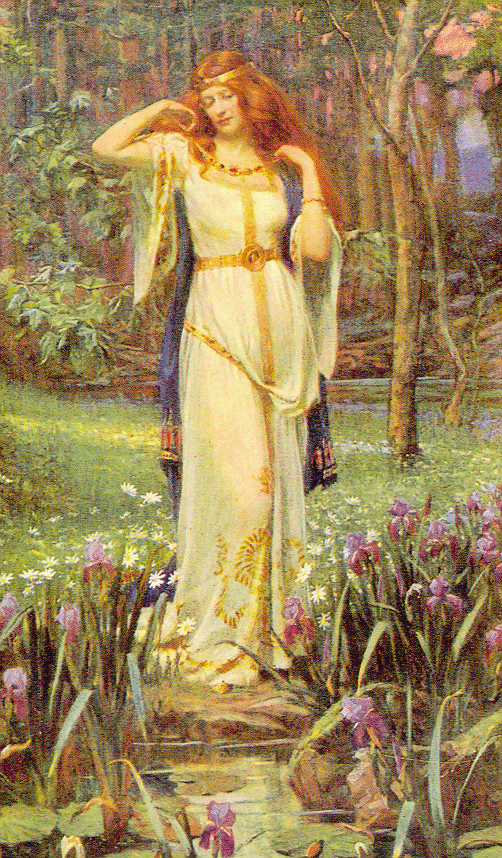
The Valkyries carry out the will of Odin in determining the victors of the battle, and the course of the war. Their primary duty is to choose the bravest of those who have been slain, gathering the souls of dying heros or warriors found deserving of afterlife in Valhalla. They scout the battle ground in search of mortals worthy of the grand hall. If you are deemed by the Valkyries as un-worthy of the hall of Valhalla you will be received after death by the goddess Hel in a cheerless underground world.


The descriptions of Odinn's hall describe the Valkyries as foster-daughters, just as the einherjar (the chosen warriors of Odinn) are foster sons. Freyja is said to be the first of the Valkyries, called Valfreyja, "Mistress of the Slain," she pours ale at the feasts of the Aesir . The Valkyries also have duties in the great hall. There, having exchanged their armor for pure white robes, they will serve the warriors they have chosen.


Valhalla, the great hall of slain warriors is located in Asguard, the realm of Odin. It contains 540 doors each of which leads to a room which can accommodate 800 warriors. The roof is made of warrior's shields. There the warriors spend their days fighting and their nights feasting, until Ragnarok, the day of the final world battle, in which the old gods will perish and a new reign of peace and love will be instituted.

There are several traditional names for Valkyries mentioned in the sagas and the Eddas:

Brynhildr ("Byrnie of Battle" or "Mail-coat of Battle")

Sigrdrifa ("Victory Blizzard")
Sigrún ("Victory Rune")

Sváva KáraHrist ("The Shaker")
Mist ("The Mist" or "The Fog")

Skeggjöld ("Wearing a War Axe")
Skögul ("Battle" or "Rager")

Hildr ("Battle")
Þrúðr ("Power")

Hlökk ("Noise", "Din of Battle")
Herfjötur ("War-Fetter")

Göll ("Loud Cry", "Battle Cry")
Geirahöd ("Spear of Battle")

Randgríðr ("Shield of Peace")
Ráðgri'ðr ("Counsel of Peace" or "Gods' Peace")

Reginleif ("Heritage of the Gods")
Gunnr ("Battle")

Róta ("She Who Causes Turmoil")
Skuld ("She Who Is Becoming")

Göndul ("Magic Wand" or "Enchanted Stave")
Friagabi ("Giver of Freedom")

The Valkyries are connected with the legend of the Raven Banner. This banner was woven of the cleanest and whitest silk and no picture of any figure was found upon it except in the case of war, at which time a raven always appeared upon it, as if woven into it.

If the Danes were going to win the upcoming battle, the raven appeared with his beak wide open, flapping its wings and restless on its feet.

If they were going to be defeated, the raven did not stir at all, and its limbs hung motionless.
Sometimes the blood-covered Valkyrie-prophetesses are seen themselves as weavers, to prophesy the outcome of the next day's battle.

The Valkyries are also Odin's messengers and when they ride forth on their errands, their armor causes the strange flickering light that is called the "Aurora Borealis" (Northern Lights).

Depending on who you talk to, the number of Valkyries varies from three to sixteen.
Any maiden who becomes a valkyrie will remain immortal and invulnerable as long as they obey the gods and remain virginal.

It is often said that if you see a Valkyrie before a battle, you will die in that battle.

The Valkyries appeared riding in a troop, often of nine war-like women.

Thank you dearest friends and followers for visiting my blog and reading todays posting on Iroquois legends. Your comments, thoughts ideas and suggestions are always most welcome, thank you
ڰۣ With love from The Fairy Lady ڰۣ✿ 

Monday, 4 August 2014

WHY THE PARTRIDGE DRUMS

Hi dear friends and followers. Today we visit the Iroquois legend of how the origin of the partridge. Have a great read.  
This posting tells us why a certain bird makes a certain noise in the forest, a noise different from all of the other birds. It's not a chirping or a screeching or any sort of song. It makes a noise with its wings. Here is why the Iroquois say it is so.

WHY THE PARTRIDGE DRUMS

It was after the Great Spirit had made all of the beautiful birds that the Evil Spirit came along. He saw the beautiful birds and heard their beautiful songs. He saw that the Earth people liked the birds and liked to hear them sing.

Now the Evil Spirit did not wish for people to be happy, so he said, “I will make a bird that will make people afraid. I will make a big bird that will not sing, but will make a great noise.”

So the Evil Spirit went to work. In a short time he had made a big bird that could not sing, but could drum.
The big bird flew away into the wood. That night a drumming noise was heard in the wood. The people were afraid. They could not sleep because of the noise.

In the morning they went into the woods to search for the noise. Deep in the forest could still be heard that strange drumming. They followed it until they came to a dark place deep in the woods. There was a loud fluttering and whirring of wings, and a great bird flew out among them, along the ground and over the trees.

The people were afraid. They called to the Great Spirit to help them.
The Great Spirit was near. He heard their cry, and went after the bird, for he was very angry.

The Great Spirit said, “I will not have my people frightened by this great bird; it shall die.”

The big bird gave the Great Spirit a long chase. At last the Great Spirit came upon it. He seized it, and threw it against a large tree.

As the big bird struck the tree, drops of blood flew in all directions. They changed into smaller birds that went whirring into the woods, just as the big bird had done. There they began to drum.

Like the big bird, these smaller birds like to startle people. They flutter out from under the leaves, and with a whirring noise they fly far into the wood. They perch on an old log, or a rock, and drum with their wings.

Some of the Earth people say they are drumming for their mates. But others still think that the birds drum to make people afraid.

So this is how the Indians say the partridges came to be. This is why they drum, and why some of the Earth children still love to hunt partridges.
Thank you dearest friends and followers for visiting my blog and reading todays posting on Iroquois legends. Your comments, thoughts ideas and suggestions are always most welcome, thank you

ڰۣ With love from The Fairy Lady ڰۣ


Sunday, 3 August 2014

!!!! The Shadow Elves !!!!

Hi, Dear Friends and Followers! I would like to share with you once again one of my short story poems. I hope that you find this poem to be an interesting read. Thank you for reading and have a wonderful day!


!!!! The Shadow Elves !!!!


The elves of yesteryear are now no more than shadows,

shadows flitting to and fro among the forest's trees.

Once they were a mighty race, a peaceful lot they were.

They were happy, and content to live out their long lives,

in the enchanted forests and fields of Averie.

But such peace grows lesser as their forest homes shrink

ever more made smaller, each year by year.

Some retreated to the other world but many stayed

in the hope of saving what was once their peaceful home.

Man had come in and taken over the land.

The elves knew they were no match for men.


For warriors of old and great renown

had changed their ways and renounced the sword.

The shadow Elves had lowered their weapons

and had vowed to sue for peace and fight no more.

I cannot read their minds but I would have to say,

that there is sadness, not contempt in their hearts,

for the invaders in their land, those called human.

The elves moved with the wind through forest, like shadows.
Without sound, true form, or voice, or noise, like wandering souls,

from another time, in a different world, a strange new way, like fog;

they approached at once, to the River Wye,

The river of gnomes, and fairies, and elves.

There they were, in green forest by the gurgling waters of the Wye,

that sparkled like diamonds in the noonday sun.

" I am Silon," said he at the point, “and my companions,”

as he waved his arm toward the horde at his right.


“We have come to your aid, if you so desire, my Lady Valori!”

Silon, upon a branch of a gnarled and ancient oak,

doffed his plumed hat, bowed his head and further spoke:

“At your service, my dear Lady Valori. At your disposal are we.”

He jumped down. From the ground he measured

not an inch more the two feet.

“We hail from the realm of the forest of Scrioux.

Our original mission was to hunt down the Ddraig,

the dragon of long, long ago, but our mission failed.

“Then the humans came and we were attacked.

We need to find Ddraig now, not to slay but to bring back its scales.


But all dragons have gone, long, and long ago,

and we could not complete the mission.

“So our punishment is to be trapped in time between time.

Until such a time the dragon Ddraig is found;

Until then shall we remain in the world of shadows.

There are great healing properties within the scales

that we extract from the them.

“But for whatever reason Ddraig never returned.

We come to you for your help, Lady of the Forest.

We need your help to find the time and place where the dragon hides.

We need this favor from you so we can find the scales,

so we can heal this world of its sickness.

“Last we had tracked it back to this dark forest,

when we were thrown into time between time.

We then saw the encounter you had with the beast,

and also saw you banish the Ddraig altogether,

by your most awesome power and cunning and skill.

“So, my Lady, I have seen you there all those years ago.

All we seek is the secret to open time between time,

so that we might pursue and complete our mission."

" I have no ill will toward you for we have failed in our mission.

My only desire is to transform our failure.

You only did at the time what you thought was good for all.”


Valori replied, “I then saw the helmets of the Shadow Elves

light up in patterns distinct and strong.

I felt as though they were studying me somehow.

“Then I knew, I remembered that faithful day long ago,

with the sorcerers sword in hand, I split the air asunder

and in a great flash of light, Ddraig was swallowed up

and never seen again. I had fainted and remembered nothing.”

As Valori spoke she also recalled

that she had hidden the Sorcerers sword.

It was in the hay loft of an old barn,

Safe from those who had no business with it.

Shall we fetch the sword that you need to further your work?

Lady Valori asked of the Shadow Elf leader?” “Indeed!” replied he.


The lady bowed in respect and handed the sorcerers sword to the Elf.

Silon returned to his fellows and as they walked,

they slowly faded and vanishes like ground fog.

Continued.

Thank you dearest friends and followers for reading this interesting story poem on the shadow elves, Your comments, thoughts ideas and suggestions are always welcome her, thank you

Written by me, Cynthia ©

ڰۣ With love from The Fairy Lady ڰۣ✿ 


Saturday, 2 August 2014

Frizzy Lizzy here, welcome friends. {;o)


Hi dear friends and followers. It is Saturday again, Frizzy Lizzy time, my the weeks go fast. Well come on in and make yourself at home.  

Men are so darn predictable, aren't they? When I need to get my Charley out of my way for a time I just ask him to work on something for me. It never fails that within a few minutes after he starts he finds out that he needs parts and off he goes to the hardware store. If I really want him gone I suppose that I could ask him to clean out the garage!

Anyway, while he's on a parts run, sit down and let's have a coffee. Glad you could make it!

I do put in some time on Facebook, I admit it, and so does Charley. Have you seen that joke that's making the rounds, the one in which the man tells his female partner that she has a butt as big as their barbecue grill? And she tells him that if he thinks that she's going to get that grill all hot for a weenie as small as his, he can dream on?

Well, Charley read that one and he thought that it would get a laugh out of me. What he didn't know is that I had already seen it and although I thought it was a cute joke I didn't laugh. No, not me. Instead of telling him how clever he was I told him that this grill needed some variety and wanted to have some Italian sausage. Next thing I knew he was heading for the neighbor's with a baseball bat in his hand. The neighbor is Luigi.

Looks like Charley got me on that one! He came back with a beer in his hand and he and Luigi laughing like two fools! That's OK. I'll fix him later/.

It's steak time on the barbecue tonight. I like using the term "I like to rub my meat with lemon and spice"...it never fails to make most men giggle like a bunch of morons. Jeeze! Do they ever think of anything else? Now there's the answer for Charley. He can rub his own meat!

Thanks for coming by. I'm glad you were here to see this. I couldn't make this stuff up. Yep, that's life with Charley. You can bet that tonight he'll hear the three little words that mean so much to a man: You're cut off!

Thank you very much for dropping by. Don't be shy and sahre your thoughts ideas and suggestions with us. 

ڰۣ With love from The Fairy Lady ڰۣ

See you later! 


Friday, 1 August 2014

Runes ~ ancient symbols Predating writing

Hi,  Dear Friends and Followers!  Today we take a look at ancient symbols called Runes.  We touch on their origin, their ancient uses, and what we understand of them to date. I hope that you find this topic to be interesting.  Thank you for visiting and have a wonderful day!

Runes ~ ancient symbols
Predating writing


No one knows exactly how old the runes are. Rune-like symbols appear as cave markings as early as the late Bronze Age (circa 1300 BC), and they are mentioned in the Bible, but their use in ritual and as an Oracle for consultation must certainly predate their use as a system of writing.

Eminent scientific runologist Dr R. I. Page of Cambridge University (An Introduction to English Runes 1973,1999 and Reading the Past - Runes 1987) notes that the runic forms were well established and gave the appearance of having been in use for some centuries before the time of the earliest written language inscriptions.
The fact that the runes were each given meaningful names confirms that they had some magical or religious significance to their users long before they emerged as an alphabet for records and messages.

The word rune itself comes from the old Norse word Runa meaning a secret or mystery, and it seems likely that the early runemasters and runemistresses were considered to have some magic or mystic power in their understanding of the runes.

The runes represent objects, gods, people, animals, concepts and occurrences. They were known by names from which their alphabetic and phonetic values were taken, but it must be remembered that the early Germanic and Norse tribes who developed them did so long before they had any need for writing messages.

The later Roman historian Cornelius Tacitus (58-120AD) records a Germanic tribal Runemal in some detail in Chapter 10 of his ethnographical work Germania from about 97AD when he was Consul to the region:

To divination they pay much attention. Their method is a simple one: they cut a branch from a fruit-bearing tree and divide it into small pieces which they mark with certain distinctive signs and scatter at random onto a white cloth. Then the priest of the community (if it is done publicly) or the father of the family (if it is done privately) after invoking the gods and with eyes raised to heaven, picks up three pieces one at a time and interprets them in accordance with the signs previously marked on them.

When the high chieftains and lawgivers of Anglo-Saxon England met in secret, their assemblies were known as The Runes: and a 4th Century translation of the Bible uses the word Runa for "mystery" or "secret proceedings".

It was not until about AD200, when the runemal (i.e. the art of runic interpretation) was wide-spread in Northern Europe that the runic alphabet emerged. This alphabet became known as the Futhark or Futhorc, after the names of the first 6 runes (Fehu, Uruz, Thurisaz, Ansuz, Raido, Kauno) and it is these 24 symbols that now comprise the rune set. Some modern diviners also use a blank to represent Odin, fate or destiny - but it is probably more useful as a spare in case of loss. A blank cannot rightfully be called a "rune" because there is no symbol on it. And in any case, the rune Ansuz is generally accepted to represent Odin by the majority of experienced rune users.

There are very few surviving runic inscriptions and most of them are on stone or metal - the most durable of materials. Only a handful of inscriptions carved on wood have ever been found, and none of these is from Britain.

There is sufficient evidence to show that the Ancient Pagan or Anglo-Saxon runes (known to runologists as the Anglo-Friesian runes from their geographical occurrence) are the same 24 basic runes with variations in their form due to usage over the centuries.

For example, the Hagalaz of the Norse resembled an angled H but the Anglo-Saxons added a second cross-bar.

The ancient Norse prose tales of the Edda have Odin hung on the World Tree when he spies the runes and seizes them up to gain wisdom and well-being. The Edda also mentions Bragi, master of the skalds (minstrels) and a great storyteller who reputedly had runes tattooed on his tongue - a reference to his magical gift as a raconteur.

The slightly later poem Erik the Red describes a Runemistress in full regalia.

Coming to modern references, the traditional lore of Finland as recorded in the Kalevala by Lönnrot in 1835 describes a confrontation of wizards where runic songs were used to cause fire and devastation.

Some modern experts allege that stones were commonly used for the Runemal, but I have found no evidence of this despite extensive research. The indications, whether from runology, known Pagan religious beliefs, or Saxon witchcraft ritual, all point to the use of wood, particularly from fruit-bearing trees.

A lot have been said on the origin of the runes. And despite this, not much is certain about the actual truth of their origin. A main reason for this problem, might be that we are simply looking for the answers in the wrong places, or otherwise in periods of time too close to our present day in history.

Basically, the runes never left the scene. Despite the attempts by the Christian church to ban their use at several points of time in history, and despite and the introduction of an alternative alien writing system that came to dominate Europe. Instead they were in use from their very distant past, all into our present day. Some attempts were made for example in Sweden during the early 17′th century – mainly due to the efforts of Johannes Bureu

.

Others advocated their use as sinnbilder (icons/symbols) of various meaning. In particular the later use, as symbols, had quite some success in the late 1800′s and early 1900′s in Germany and Scandinavia, during the Völkisch

and Göticism

movements. And indeed, even in present day Sweden (and elsewhere, of course) the runes live on as rather mundane symbols on, for example, road signs, and for branding of eggs, to mention a few. The bindrune of Bluetooth (as in Harald Bluetooth ) is another fine example of this.

Actually, a rather modern set of runes – the Dalecarlian Runes

– were very much alive and in everyday use as a writing system in Dalarna/Sweden, as late as in the 20′th century.Murarmärken/Stenhuggarmärken (mason’s marks ) and Bomärken (house marks ) often have undeniable runic origins, and have pretty much been in continuous use in northern Europe from times immemorial until present day history.
PART 2

Runes and academics
M.R. James, “Casting the Runes,” 1911

There’s a peculiar tendency among scholars, historians and archaeologists alike when it comes to all things northern European. As soon as they come across something remarkable, such as high grade steel swords, advanced surgical tools, precision lenses (suggested uses for these have been either for medical purposes, fire starting, binoculars or simply for magnification), navigation equipment (suggesting we were aware that the world was round, and not flat), welding and soldering techniques impossible to mimic with modern jewelers tools etc., they scratch their heads and question themselves 

“Where did this come from? Who taught them to do this?”. Just as if it was virtually impossible for anyone of northern European descent, to actually possess a constructive and innovative mind. This is indeed a weird way of looking at things, if you consider how many modern day inventions that actually originate from Scandinavia and northern Europe in general – where some countries have a total population comparable to larger cities in other parts of the world. Our DNA haven’t changed so much, that we turned from primitive imbeciles into scientific masterminds in merely some 50 generations. It doesn’t make any sense.

Frankly, had the same logic been applied to just about any other ethnic group, a public apology and official statement denouncing their unintentional but still degrading “colonialist attitude”, had been issued faster than anyone could scream “racial bias”.

In all honesty, we all know this is nothing but deliberate lies. At best it’s about not knowing better. But there’s no reason to allow ourselves to get upset by such bigotry. We are above that. But surely, it’s still worth having in mind whenever you read, hear or watch anything concerning pre-Christian northern European culture. In days like these, you really don’t have to be a part of their agenda. Just don’t jump their bandwagon. We can run our own show.

So where do these runes come from? If the answer that “Odin took them up screaming” – and that Rig then passed them on to us humans, as he taught them to Jarl – ain’t good enough for you, then the answer pretty much is we don’t know for sure. As simple as that.

Thank you dearest friends and followers for reading this interesting topic on ancient runes, Your comments, thoughts ideas and suggestions are always welcome her, thank you

ڰۣ With love from The Fairy Lady ڰۣ